

What's Up With Lawns?
Have you ever looked at someone's lawn and thought, "What's the point?”
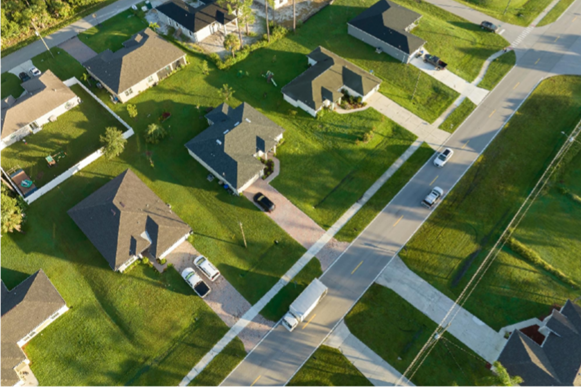
I am always struck by the stark difference between a forest preserve and the property that backs up to it. One is a complex living entity unto itself, the other is a green scar that dots the landscape. One holds the promise of a thriving ecosystem with plants, animals and fungi all interacting to keep the forest alive, the other mows, sprays pesticides, and pulls unwanted inhabitants in order to keep its verdant blanket unfettered. Why? Where did this obsession over landscaping perfection come from? What are its effects? And how can we change?
I remember being a kid and watching my dad diligently mow the yard on a hot summer's day, in his dago tee and cutoff jorts. Walking back and forth, back and forth, yelling at me over the encapsulating din created by his red lawn mower for a glass of water. What was he doing out there? Why was he mowing the grass of course. But what did that do? It makes the house look neat and tidy of course, and everybody wants to seem neat and tidy, don't they? That's why they get haircuts, why they wear nice clothes, it's why my dad shaved every morning of his adult life, because people wanted to be neat and tidy.
Lawns are not a new thing - they have been around for hundreds of years, with the origins being attributed to large areas of grazed land. Sheep or cows would come in and eat any grass that is above the surface. Then the animals would be removed from the field and the grass that was consumed would be allowed to regrow. This seems to be a very different function to the lawns that have become so ubiquitous.
It is a rare sight indeed to see a flock of sheep grazing in the front yard of some isolated subdivision in American suburbia. So why did the nature of lawns change? Lawns were a place to graze your flock, and after being grazed, the field was used as a communal green, where sports would be played, festivities would be had, and people would gather. This would change around the time of the European Enlightenment.
Out was the communal agrarian society, and in its place was man's domination over nature. Thanks to ideas like Rene Descartes' man/nature dualism as well as the public/private distinction, lawns changed from a commodity of use-value to one of aesthetics. Things began to change in the 19th century. Elites in places like England and France had consolidated vast wealth due to their imperialistic and colonial policies and one way that individuals learned to display that wealth was through the cultivation and maintenance of lawns. The bourgeois of the time needed people to know that they could afford to keep their grass at constant grazed height, that they had the resources to hire individuals to take care of their lawn, and that they did not need that space for any type of subsistence gardening. The rich people were showing off, essentially. For they were so rich, that they were even above the natural environmental order.

That is where we pick up lawns today. People still see the yard as a space to confirm our dominance over the natural world. “Look how monocultural my yard is, I have had to pull so many weeds to keep it this way.” These are the supposed words of some middle aged suburbanite male as he canvases his plot. The lawn is nothing besides humanity's statement to nature saying “I can do what I want, see?” It’s like a child that has just discovered that they can do half a cartwheel and now they is making every adult in a 1-mile radius watch as they fail to tumble over their head. It is infantile to promote our “control” over nature.
There are almost 50,000 square miles of manicured lawns in the United States, an area roughly the size of Mississippi. Each of these lawns requires water to maintain it, mostly gas-powered machinery to cut it, and the use of pesticides, herbicides, and fungicides to sustain it. We are dumping resources into a vanity project. While large parks and squares create value to society, by creating sporting areas, meeting areas, play areas and so forth, the private individual lawn is nothing but a drain on the resources of our society and a source of significant toxic chemical inputs to the environment.
What can we do? The very first thing we can do is eliminate lawn mowing. The artificial manicured lawn is only so unnatural because of the role humans take in its life cycle. Nothing about it is natural. We give it water when it is thirsty, we feed it nutrients when it is hungry, and we pull anything that may compete with its resources. The quickest thing to do would be to eliminate human interference as much as possible. Let the grass live and die on its own, let it grow out, let it become pollinated, let it multiply. Let animals make the tall grass their home, and increase the livable area for all kinds of life simply by eliminating mowing.

The second thing I would suggest is the continuous replacement of unnatural lawns with more natural and local wildlife. This is something that would take more time and more organization. It is hardly feasible for an area the size of Mississippi to be replanted in a week, but with policy changes as well as an increase in cultural awareness we can help naturalize our world once again.
We live on a finite planet, and in a world where resources are already thin, where tensions are high and only getting higher - why are we wasting our time and resources on something as useless as lawns? We do we not exercise some of that creative humanity we all have the capacity for? Why don't we ingratiate ourselves into the natural process instead of trying to divert it? By eliminating lawns perhaps we can begin to move back into harmony with nature.

Comments