

Crayfish and Their Fight for Rights
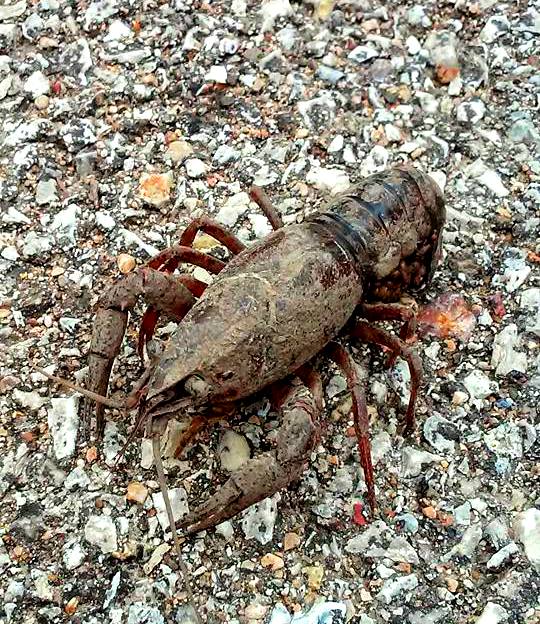
The date was March 31st 2026, a damp Tuesday afternoon right after I had just finished my Ecology and Philosophy class. On my walk to my car I caught a glimpse of a weird little alien walking across the sidewalk. As one does after catching a glimpse of a weird little alien, I came closer to inspect what it was doing in the parking lot of our campus. Upon further inspection I discovered that it was not an alien, but a crayfish that was on a pleasant stroll that day. As I got into my car and started to drive home I thought to myself, why did this creature look so out of place?
The conclusion I made was that it was not the crayfish that was out of place, it was the parking lot and perhaps me that was out of place. The crayfish has probably traveled that way for generations and it just so happened that now there was now a gigantic parking lot in its path. We always say respect your elders, yet these creatures have been on earth for roughly 250 million years compared to our measly 300 thousand years, yet we never thought once to include them into the discussion of whether or not a parking lot should be built around the woods and the vernal ponds which created habitat fragmentation causing the crayfish’s beautiful red shell to contrast the dull gray concrete in front of me as I stood there pondering. The issue is if my eyes alone can see a crayfish walking down the street, then I guarantee that a hawk, crow, or heron can also locate this creature with ease.

What can we do about this crayfish’s supposed “rights” that have been supposedly violated? Well first, can crayfish have rights in our society? In Robyn Eckersley’s article Liberal Democracy and the Rights of Nature: Struggle for Inclusion. She states that “The extension of full citizenship rights to slaves, blacks and women was appropriate because they are all people who are capable of participating in political life.” (Eckersley p. 191) For the case of the crayfish, as far as we know they cannot participate in political life and therefore cannot be granted full citizenship like humans and the rights that come with that. But even though we cannot grant the crayfish human citizenship, Eckersley argues that we should separate animals into a “different kind of community that is constituted by a different set of relationships." (Eckersley p. 192) She poses this viewpoint because what rights humans and animals want are mostly different. We do not need the right to burrow into the ground to hatch eggs, and crayfish do not need the right to vote where their taxes are going. Eckersley also posits that we should recognize basic moral rights to animals (in this case the crayfish) because we as people have undermined their autonomy and demolished lands that did not exist before human interference.

Even though crayfish can’t participate in our politics doesn’t mean that there aren’t ways that they can be represented. In our current political system we vote to have someone represent us as the people. In Eckersley’s article she talks about the idea of having a “legal guardian who could ensure that the interests of a natural entity is protected.. Making legal action on its behalf in order to make good any injury inflicted on it." (Eckersley p.192) This illustrates that there could be some sort of crayfish representative that has researched and knows enough about crayfish who would then fight on behalf of what interests we can surmise that a crayfish might want in their lives. This would not be unheard of especially when you consider the fact that most politicians make choices on our behalf without ever needing to live like the average voter.
In conclusion, this parking lot was constructed with an anthropocentric view which is used to convenience people while inconveniencing other creatures. We don’t know if the crayfish that walk around the parking lot to disperse their babies in the spring are greatly inconvenienced by it, maybe it helps them get to their destination faster. Although evidence of crayfish squashed by cars in the parking lot is not difficult to come by each spring. So perhaps we should consider asking the locals before haphazardly building on the land to suit our own needs, because you never know what negative long term effects could arise for other organisms that may be worthy of our moral consideration.


Comments